

1Z0-902 Dumps with Free 365 Days Update Fast Exam Updates
Verified 1Z0-902 dumps Q&As - 2024 Latest 1Z0-902 Download
Oracle 1z1-902, also known as the Oracle Exadata Database Machine X8M Implementation Essentials certification exam, is designed for professionals who want to demonstrate their expertise in implementing and maintaining Oracle Exadata Database Machine X8M systems. 1Z0-902 exam covers a wide range of topics, including hardware and software installation, configuration, and troubleshooting, as well as database management and monitoring. Oracle Exadata Database Machine X8M Implementation Essentials certification is ideal for individuals who work in database administration, IT management, or cloud computing.
Passing the Oracle 1Z0-902 certification exam not only validates your expertise in Oracle Exadata but also demonstrates to potential employers that you are a skilled and knowledgeable professional in the field. Certified professionals are highly sought-after in the industry and can expect to earn higher salaries and enjoy better job prospects. Whether you are looking to advance your career or enhance your technical skills, the Oracle 1Z0-902 certification exam is a valuable investment in your future.
NEW QUESTION # 16
How is Exadata Secure RDMA Fabric isolation used in X9M-2 with virtualization enabled?
- A. With Secure Fabric isolation, each Database VM Guest uses a dedicated network partition and VLAN ID for client networking between application servers. This improves security by preventing man in the middle attacks.
- B. With Secure Fabric isolation, each Storage Server runs multiple KVM guests each dedicated to a Database VM cluster using a dedicated network partition and VLAN ID. This provides security and isolation between multiple tenants or VM clusters.
- C. With Secure Fabric isolation, each Database VM Cluster uses a dedicated network partition and VLAN ID for Data Guard networking between the primary and disaster recovery Exadata racks. This improves security by isolating data guard traffic onto an encrypted network between data centers.
- D. With Secure Fabric isolation, each Database VM cluster uses a dedicated network partition and VLAN ID for cluster networking between the database servers in the VM Cluster. This provides security and isolation between multiple tenants or VM clusters.
Answer: D
Explanation:
Exadata Secure RDMA Fabric isolation is a feature that allows you to use virtualization on the X9M-2 platform while maintaining security and isolation between multiple tenants or VM clusters. Secure Fabric isolation works by creating a dedicated network partition and VLAN ID for each Database VM cluster, which is used for cluster networking between the database servers in the VM Cluster. This ensures that the network traffic of each VM cluster is isolated from the others, and it prevents unauthorized access to the data or resources of other VM clusters. Secure Fabric isolation can also be used for other purposes such as client networking, Data Guard traffic, but it's mainly used to provide security and isolation between multiple tenants or VM clusters.
NEW QUESTION # 17
You are working on a remote Exadata Database Machine with current software and firmware. You now need to start a storage server after hardware maintenance.
Which ILOM command starts the storage server?
- A. You must be physically present in the data center to start an Exadata Storage Server.
- B. -> set /SYS power_state=ON
- C. -> start /SP/console
- D. -> start /SYS/power
- E. -> start /System
- F. -> start /SYSTEM/power
Answer: D
Explanation:
ILOM (Integrated Lights Out Manager) is a remote management system that allows you to control and monitor Exadata Database Machine components, such as storage servers and database servers, from a remote location. The command "start /SYS/power" is used to power on the storage server in the Exadata Database Machine after hardware maintenance. This command can be executed remotely via ILOM.
NEW QUESTION # 18
Which are two correct statements for managing virtual deployment using Oracle Exadata Deployment Assistant (OEDA)?
- A. There is no limit on the number of VMs in an Exadata rack as long as the Exadata rack has adequate resources.
- B. OEDA sets up key-based authentication for the root user by using the setuprootssh.sh utility included with OEDA.
- C. OEDA deployment steps include calibrate cells, create cell disks, and resecure machine.
- D. OEDA allows customers to have both bare metal (BM) and virtual machine (VM) in an Exadata X9M Quarter Rack.
Answer: B,C
Explanation:
C) OEDA deployment steps include calibrate cells, create cell disks, and resecure machine2.
D) OEDA sets up key-based authentication for the root user by using the setuprootssh.sh utility included with OEDA2.
NEW QUESTION # 19
You are adding a disk expansion kit to a running Exadata X8M Database Machine's Database Servers, and have a filesystem layout that includes: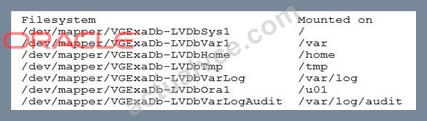
After running the following commands, which command needs to be run to add 20G of space to the filesystem mounted on /u01?
- A. # lvextend -L +20G -verbose /dev/mapper/VGExaDb-LVDbOral
- B. # xfs_growfs /uOl +20G
- C. # lvextend -L +20G -verbose /dev/VGExaDb/LVDbOral
- D. # resize2fs +20G /dev/VGExaDb/LVDbOral
Answer: A
NEW QUESTION # 20
Which three steps are required to expand an Exadata X9M-2 Database Server with the lowest memory configuration available to the highest memory configuration?
- A. Add 12x 32GB DIMMs.
- B. Shutdown the Database Server if running.
- C. Memory cannot be expanded on Exadata X9M-2 Database Servers.
- D. Add 16x 32GB DIMMs.
- E. Add 16x 64GB DIMMs.
- F. Add 24x 32GB DIMMs.
- G. Remove existing memory modules.
- H. Add 12x 64GB DIMMs.
- I. Add 32x 64GB DIMMs.
Answer: B,E,G
Explanation:
1. Remove existing memory modules: Before adding new memory modules, the existing memory modules should be removed.
2. Add 16x 64GB DIMMs: The new DIMMs should be added, in this case is 16 DIMMs of 64GB each, which will expand the memory to the highest configuration available.
3. Shutdown the Database Server if running: The Database Server should be shutdown before adding new memory modules in order to prevent any possible data loss or corruption.
The steps required to expand an Exadata X9M-2 Database Server with the lowest memory configuration available to the highest memory configuration are as follows:
Shutdown the Database Server if running.
Remove existing memory modules.
Add 16x 64GB DIMMs.
For reference, the Oracle Exadata Database Machine X9M Implementation Essentials Official Text Book states that "the lowest memory configuration for the Exadata X9M-2 Database Servers is 384GB and the highest is 768GB [1]. The memory upgrade is done in increments of 64GB using 16x 64GB DIMMs".
NEW QUESTION # 21
Which two statements are true about Auto Service Request (ASR) with an Exadata Database Machine?
- A. ASR can upload configuration metadata to support problem resolution.
- B. ASR Manager opens a service request (SR) automatically after sensors detect hardware faults.
- C. ASR Manager must be installed and configured on one of the database servers.
- D. ASR communicates with Oracle support services using HTTPS.
- E. ASR Manager must be installed and configured on a dedicated server external to the Database Machine.
- F. Configuring ASR is mandatory for all Database Machine assets.
Answer: B,E
NEW QUESTION # 22
You have been asked to investigate why an Exadata Database Server stopped communicating on the client network for 10 minutes over the past weekend.
Which command would help investigate this?
- A. $ ${ORACLE_HOME}/suptools/tfa/release/tfa_home/bin/tfact1 -from <Fridays_Date>_17:00:00 -to <Sundays_Date>_23:59:00
- B. # /opt/oracle.SupportTools/ibdiagtools/netcheck/runDiagnostics.pm -from <Fridays_Date>_17:00:00 -to <Sundays_Date>_23:59:00
- C. # /opt/oracle.ExaWatcher/GetExaWatcherResults.sh -from <Fridays_Date>_17:00:00 -to <Sundays_Date>_23:59:00
- D. # /opt/oracle.SupportTools/exachk/exachk -from <Fridays_Date>_17:00:00 -to <Sundays_Date>_23:59:00
Answer: C
Explanation:
https://docs.oracle.com/en/engineered-systems/exadata-database-machine/dbmmn/maintaining-exadata-database-servers.html According to Oracle's documentation1, one of the utilities for diagnostics and repair of Oracle Exadata Storage Server is ExaWatcher, which collects operating system and network metrics on database servers and storage servers. The utility is located in the /opt/oracle.ExaWatcher directory1.
To investigate why an Exadata Database Server stopped communicating on the client network for 10 minutes over the past weekend, you can use the GetExaWatcherResults.sh script to collect and analyze ExaWatcher data for a specified time range1.
Therefore, the command that you should use to investigate this is:
/opt/oracle.ExaWatcher/GetExaWatcherResults.sh -from <Fridays_Date>_17:00:00 -to <Sundays_Date>_23:59:00
NEW QUESTION # 23
Which two sections of the AWR report shows statistics for X9M Persistent Memory Cache?
- A. PMEM Pool Misses in the Exadata Outlier Summary
- B. PMEM Cache section within Exadata Smart Statistics
- C. PMEM Pool cache Read Hits in the Cache Sizes portion of the Report Summary
- D. cell PMEM cache Read Hits in the Database IOs portion of the Performance Summary
- E. PMEM Cache section within Memory Statistics
Answer: D,E
Explanation:
The "cell PMEM cache Read Hits" in the "Database IOs" portion of the "Performance Summary" will show the number of reads that have been satisfied from the Persistent Memory Cache. The "PMEM Cache" section within "Memory Statistics" will give detailed information about the usage of the Persistent Memory Cache, such as cache size, used size, hit rate, etc. This information can help to identify if the Persistent Memory Cache is being used effectively and if there are any issues with it.
NEW QUESTION # 24
Your customer needs to ensure that their data is available on the Exadata machine during updates. The customer wants to be able to update one server at a time but still be protected against single-node server failure.
What ASM redundancy level should they use?
- A. High
- B. Sparse
- C. Extended
- D. Normal
- E. External
Answer: A
Explanation:
https://www.oracle.com/technetwork/database/exadata/maa-exadata-asm-cloud-3656632.pdf
NEW QUESTION # 25
How do ASM failure groups provide redundancy?
- A. Extended Redundancy mirrors data across data centers providing the highest levels of data protection.
- B. They ensure that the ASM Flex instances are enabled on a maximum of two database servers or VMs per cluster.
- C. Failure groups are created for each grid disk to ensure mirror copies are written to the same storage server for faster recovery after a physical disk failure.
- D. Failure groups contain all ASM disks in a single storage server preventing mirror copies being written to the same storage server.
Answer: C
Explanation:
Failure groups provide redundancy in Oracle Exadata Database Machine X9M by ensuring that mirror copies of the data are written to different storage servers [1][2]. This prevents the potential for mirror copies to be written to the same server, which would cause a data loss if that server were to experience a physical disk failure. Furthermore, failure groups help to ensure that the ASM Flex instances are enabled on a maximum of two database servers or VMs per cluster, providing an extra layer of data protection. Additionally, Extended Redundancy mirrors data across data centers, providing the highest levels of data protection. Reference: Oracle Exadata Database Machine X9M Implementation Essentials [1][2], Chapter 5: Configuring Oracle ASM.
NEW QUESTION # 26
Examine this list of software components:
1. Oracle KVM Guest
2. Oracle Enterprise Manager Agent (OMA)
3. ASM instance
4. RDBMS instance
5. Automatic Diagnostic Repository Command Interpreter (ADRCI)
6. CELLCLI
7. Cell Server(CELLSRV)
8. diskmon
9. Restart Server (RS)
10. Management Server (MS)
What is the correct location where these software components can run in the standard Exadata Database Machine deployment?
- A. 2, 3, 4, 8, and 10 run on the database servers; 1, 5, 6, 7and 9 run on the Exadata storage servers.
- B. 1, 2, 3, 4, 5, 8, 9 and 10 run on the database servers; 5, 6,7, 9 and 10 run on the Exadata storage servers.
- C. 3, 4, 8, and 10 run on the database servers; 1, 2, 5, 6, 7 and 9 run on the Exadata storage servers.
- D. 1, 2, 3, 4, 9 and 10 run on the database servers; 5, 6, 7, 8, 9, and 10 run on the Exadata storage servers.
- E. 1, 2, 3, 4, 8 and 9 run on the database servers; 5, 6, 7, 9 and 10 run on the Exadata storage servers.
Answer: B
NEW QUESTION # 27
Which two sections of the AWR report shows statistics for X9M Persistent Memory Cache?
- A. PMEM Pool Misses in the Exadata Outlier Summary
- B. PMEM Cache section within Exadata Smart Statistics
- C. PMEM Pool cache Read Hits in the Cache Sizes portion of the Report Summary
- D. cell PMEM cache Read Hits in the Database IOs portion of the Performance Summary
- E. PMEM Cache section within Memory Statistics
Answer: E
NEW QUESTION # 28
Which two statements are true about the initial storage configuration after the standard (non-virtualized) deployment of a new Exadata Database Machine with High Capacity storage servers?
- A. There is free space available on the hard disks inside the database servers for possible extension of the /uoi file system.
- B. There is free space available on flashdisks inside the Exadata storage servers to configure Exadata Smart Flash Logs.
- C. The DATA_<DBM_Name> and RECO_<DBM_NAME> ASM diskgroups are built on with DATA on the outer-most tracks and RECO on the inner-most tracks of the physical disk.
- D. There is free space available on flashdisks inside the Exadata storage servers for possible use for storage indexes.
- E. The sparse_<DBM_NAME> diskgroup is created automatically.
Answer: B,C
NEW QUESTION # 29
I/O performance of the prod database on your Exadata Database Machine has degraded slightly over the past month. The database has been allocated to the OLTP I/O Resource Management (IORM) category.
Which two monitoring tools might be useful in examining I/O performance for the prod database?
- A. OS I/O metrics using OS tools such as iostat on the storage servers
- B. OS I/O metrics using OS tools such as iostat on the database servers
- C. cellcli (or exacli/exadcli) to examine storage server metrics such as database, category, ceiidisk, and griddisk
- D. OS I/O metrics using Enterprise Manager host pages for the storage servers
- E. I/O-specific dynamic performance views such as v$iostat_fiie, v$iostat_function, and v$iostat_consumer_group from the prod database instances using SQL *p1us
Answer: B,C
Explanation:
The two monitoring tools that might be useful in examining I/O performance for the prod database are:
OS I/O metrics using OS tools such as iostat on the database servers.
cellcli (or exacli/exadcli) to examine storage server metrics such as database, category, ceiidisk, and griddisk.
The Oracle Exadata Database Machine X9M Implementation Essentials Official Text Book states that "I/O metrics can be collected from the database server using OS tools such as iostat [1], as well as from the storage servers using cellcli (or exacli/exadcli) to examine storage server metrics such as database, category, ceiidisk, and griddisk". It also suggests using Enterprise Manager host pages for the storage servers to view OS I/O metrics.
NEW QUESTION # 30
You must drop all celldisks on all the storage servers in an X9M-2 quarter rack as part of a reconfiguration project.
Which three statements describe the account on the storage servers which you should use and the tool that may be used to drop the celldisks?
- A. to the CELLMONITOR account calling CELLCLI on all cells using DCLI
- B. to an administrator-created storage server user with appropriate privileges on celldisk objects by calling CELLCLI on all cells using exadcli
- C. to the CELLMONITOR account using cellcli interactively on each storage server
- D. to an administrator-created storage server user with appropriate privileges on celldisk objects by calling EXACLI on all cells using exadcli
- E. to the CELLADMIN account using cellcli interactively on each storage server
- F. to the CELLADMIN account by calling CELLCLI on all cells using DCLI
Answer: B,E,F
Explanation:
To drop all celldisks on all the storage servers in an X9M-2 quarter rack, you should use the CELLADMIN account, which has the necessary privileges to perform this task. You can use the CELLCLI command-line interface to drop the celldisks. The best way to do this is by calling CELLCLI on all cells using DCLI (Oracle Database Command Line Interface) which allows you to run commands on multiple servers at once. Alternatively, you can use an administrator-created storage server user with appropriate privileges on celldisk objects by calling CELLCLI on all cells using exadcli. It is not recommended to use the CELLMONITOR account, as it has a more limited set of privileges. It is also important to note that EXACLI is not a valid tool for this task
NEW QUESTION # 31
......
Updated Oracle Study Guide 1Z0-902 Dumps Questions: https://dumps4download.actualvce.com/Oracle/1Z0-902-valid-vce-dumps.html