

Online Questions - Valid Practice To your Databricks-Generative-AI-Engineer-Associate Exam (Updated 63 Questions)
Practice To Databricks-Generative-AI-Engineer-Associate - Remarkable Practice On your Databricks Certified Generative AI Engineer Associate Exam
NEW QUESTION # 33
A Generative Al Engineer has successfully ingested unstructured documents and chunked them by document sections. They would like to store the chunks in a Vector Search index. The current format of the dataframe has two columns: (i) original document file name (ii) an array of text chunks for each document.
What is the most performant way to store this dataframe?
- A. Split the data into train and test set, create a unique identifier for each document, then save to a Delta table
- B. Flatten the dataframe to one chunk per row, create a unique identifier for each row, and save to a Delta table
- C. First create a unique identifier for each document, then save to a Delta table
- D. Store each chunk as an independent JSON file in Unity Catalog Volume. For each JSON file, the key is the document section name and the value is the array of text chunks for that section
Answer: B
Explanation:
* Problem Context: The engineer needs an efficient way to store chunks of unstructured documents to facilitate easy retrieval and search. The current dataframe consists of document filenames and associated text chunks.
* Explanation of Options:
* Option A: Splitting into train and test sets is more relevant for model training scenarios and not directly applicable to storage for retrieval in a Vector Search index.
* Option B: Flattening the dataframe such that each row contains a single chunk with a unique identifier is the most performant for storage and retrieval. This structure aligns well with how data is indexed and queried in vector search applications, making it easier to retrieve specific chunks efficiently.
* Option C: Creating a unique identifier for each document only does not address the need to access individual chunks efficiently, which is critical in a Vector Search application.
* Option D: Storing each chunk as an independent JSON file creates unnecessary overhead and complexity in managing and querying large volumes of files.
OptionBis the most efficient and practical approach, allowing for streamlined indexing and retrieval processes in a Delta table environment, fitting the requirements of a Vector Search index.
NEW QUESTION # 34
A Generative Al Engineer is tasked with improving the RAG quality by addressing its inflammatory outputs.
Which action would be most effective in mitigating the problem of offensive text outputs?
- A. Inform the user of the expected RAG behavior
- B. Curate upstream data properly that includes manual review before it is fed into the RAG system
- C. Restrict access to the data sources to a limited number of users
- D. Increase the frequency of upstream data updates
Answer: B
Explanation:
Addressing offensive or inflammatory outputs in a Retrieval-Augmented Generation (RAG) system is critical for improving user experience and ensuring ethical AI deployment. Here's whyDis the most effective approach:
* Manual data curation: The root cause of offensive outputs often comes from the underlying data used to train the model or populate the retrieval system. By manually curating the upstream data and conducting thorough reviews before the data is fed into the RAG system, the engineer can filter out harmful, offensive, or inappropriate content.
* Improving data quality: Curating data ensures the system retrieves and generates responses from a high-quality, well-vetted dataset. This directly impacts the relevance and appropriateness of the outputs from the RAG system, preventing inflammatory content from being included in responses.
* Effectiveness: This strategy directly tackles the problem at its source (the data) rather than just mitigating the consequences (such as informing users or restricting access). It ensures that the system consistently provides non-offensive, relevant information.
Other options, such as increasing the frequency of data updates or informing users about behavior expectations, may not directly mitigate the generation of inflammatory outputs.
NEW QUESTION # 35
A Generative AI Engineer wants to build an LLM-based solution to help a restaurant improve its online customer experience with bookings by automatically handling common customer inquiries. The goal of the solution is to minimize escalations to human intervention and phone calls while maintaining a personalized interaction. To design the solution, the Generative AI Engineer needs to define the input data to the LLM and the task it should perform.
Which input/output pair will support their goal?
- A. Input: Online chat logs; Output: Cancellation options
- B. Input: Online chat logs; Output: Buttons that represent choices for booking details
- C. Input: Online chat logs; Output: Group the chat logs by users, followed by summarizing each user's interactions
- D. Input: Customer reviews; Output: Classify review sentiment
Answer: B
Explanation:
Context: The goal is to improve the online customer experience in a restaurant by handling common inquiries about bookings, minimizing escalations, and maintaining personalized interactions.
Explanation of Options:
* Option A: Grouping and summarizing chat logs by user could provide insights into customer interactions but does not directly address the task of handling booking inquiries or minimizing escalations.
* Option B: Using chat logs to generate interactive buttons for booking details directly supports the goal of facilitating online bookings, minimizing the need for human intervention by providing clear, interactive options for customers to self-serve.
* Option C: Classifying sentiment of customer reviews does not directly help with booking inquiries, although it might provide valuable feedback insights.
* Option D: Providing cancellation options is helpful but narrowly focuses on one aspect of the booking process and doesn't support the broader goal of handling common inquiries about bookings.
Option Bbest supports the goal of improving online interactions by using chat logs to generate actionable items for customers, helping them complete booking tasks efficiently and reducing the need for human intervention.
NEW QUESTION # 36
A Generative Al Engineer is working with a retail company that wants to enhance its customer experience by automatically handling common customer inquiries. They are working on an LLM-powered Al solution that should improve response times while maintaining a personalized interaction. They want to define the appropriate input and LLM task to do this.
Which input/output pair will do this?
- A. Input: Customer service chat logs; Output: Find the answers to similar questions and respond with a summary
- B. Input: Customer reviews; Output Group the reviews by users and aggregate per-user average rating, then respond
- C. Input: Customer reviews: Output Classify review sentiment
- D. Input: Customer service chat logs; Output Group the chat logs by users, followed by summarizing each user's interactions, then respond
Answer: A
Explanation:
The task described in the question involves enhancing customer experience by automatically handling common customer inquiries using an LLM-powered AI solution. This requires the system to process input data (customer inquiries) and generate personalized, relevant responses efficiently. Let's evaluate the options step-by-step in the context of Databricks Generative AI Engineer principles, which emphasize leveraging LLMs for tasks like question answering, summarization, and retrieval-augmented generation (RAG).
* Option A: Input: Customer reviews; Output: Group the reviews by users and aggregate per-user average rating, then respond
* This option focuses on analyzing customer reviews to compute average ratings per user. While this might be useful for sentiment analysis or user profiling, it does not directly address the goal of handling common customer inquiries or improving response times for personalized interactions. Customer reviews are typically feedback data, not real-time inquiries requiring immediate responses.
* Databricks Reference: Databricks documentation on LLMs (e.g., "Building LLM Applications with Databricks") emphasizes that LLMs excel at tasks like question answering and conversational responses, not just aggregation or statistical analysis of reviews.
* Option B: Input: Customer service chat logs; Output: Group the chat logs by users, followed by summarizing each user's interactions, then respond
* This option uses chat logs as input, which aligns with customer service scenarios. However, the output-grouping by users and summarizing interactions-focuses on user-specific summaries rather than directly addressing inquiries. While summarization is an LLM capability, this approach lacks the specificity of finding answers to common questions, which is central to the problem.
* Databricks Reference: Per Databricks' "Generative AI Cookbook," LLMs can summarize text, but for customer service, the emphasis is on retrieval and response generation (e.g., RAG workflows) rather than user interaction summaries alone.
* Option C: Input: Customer service chat logs; Output: Find the answers to similar questions and respond with a summary
* This option uses chat logs (real customer inquiries) as input and tasks the LLM with identifying answers to similar questions, then providing a summarized response. This directly aligns with the goal of handling common inquiries efficiently while maintaining personalization (by referencing past interactions or similar cases). It leverages LLM capabilities like semantic search, retrieval, and response generation, which are core to Databricks' LLM workflows.
* Databricks Reference: From Databricks documentation ("Building LLM-Powered Applications," 2023), an exact extract states:"For customer support use cases, LLMs can be used to retrieve relevant answers from historical data like chat logs and generate concise, contextually appropriate responses."This matches Option C's approach of finding answers and summarizing them.
* Option D: Input: Customer reviews; Output: Classify review sentiment
* This option focuses on sentiment classification of reviews, which is a valid LLM task but unrelated to handling customer inquiries or improving response times in a conversational context.
It's more suited for feedback analysis than real-time customer service.
* Databricks Reference: Databricks' "Generative AI Engineer Guide" notes that sentiment analysis is a common LLM task, but it's not highlighted for real-time conversational applications like customer support.
Conclusion: Option C is the best fit because it uses relevant input (chat logs) and defines an LLM task (finding answers and summarizing) that meets the requirements of improving response times and maintaining personalized interaction. This aligns with Databricks' recommended practices for LLM-powered customer service solutions, such as retrieval-augmented generation (RAG) workflows.
NEW QUESTION # 37
A Generative Al Engineer needs to design an LLM pipeline to conduct multi-stage reasoning that leverages external tools. To be effective at this, the LLM will need to plan and adapt actions while performing complex reasoning tasks.
Which approach will do this?
- A. Implement a framework like ReAct which allows the LLM to generate reasoning traces and perform task-specific actions that leverage external tools if necessary.
- B. Tram the LLM to generate a single, comprehensive response without interacting with any external tools, relying solely on its pre-trained knowledge.
- C. Encourage the LLM to make multiple API calls in sequence without planning or structuring the calls, allowing the LLM to decide when and how to use external tools spontaneously.
- D. Use a Chain-of-Thought (CoT) prompting technique to guide the LLM through a series of reasoning steps, then manually input the results from external tools for the final answer.
Answer: A
Explanation:
The task requires an LLM pipeline for multi-stage reasoning with external tools, necessitating planning, adaptability, and complex reasoning. Let's evaluate the options based on Databricks' recommendations for advanced LLM workflows.
* Option A: Train the LLM to generate a single, comprehensive response without interacting with any external tools, relying solely on its pre-trained knowledge
* This approach limits the LLM to its static knowledge base, excluding external tools and multi- stage reasoning. It can't adapt or plan actions dynamically, failing the requirements.
* Databricks Reference:"External tools enhance LLM capabilities beyond pre-trained knowledge" ("Building LLM Applications with Databricks," 2023).
* Option B: Implement a framework like ReAct which allows the LLM to generate reasoning traces and perform task-specific actions that leverage external tools if necessary
* ReAct (Reasoning + Acting) combines reasoning traces (step-by-step logic) with actions (e.g., tool calls), enabling the LLM to plan, adapt, and execute complex tasks iteratively. This meets all requirements: multi-stage reasoning, tool use, and adaptability.
* Databricks Reference:"Frameworks like ReAct enable LLMs to interleave reasoning and external tool interactions for complex problem-solving"("Generative AI Cookbook," 2023).
* Option C: Encourage the LLM to make multiple API calls in sequence without planning or structuring the calls, allowing the LLM to decide when and how to use external tools spontaneously
* Unstructured, spontaneous API calls lack planning and may lead to inefficient or incorrect tool usage. This doesn't ensure effective multi-stage reasoning or adaptability.
* Databricks Reference: Structured frameworks are preferred:"Ad-hoc tool calls can reduce reliability in complex tasks"("Building LLM-Powered Applications").
* Option D: Use a Chain-of-Thought (CoT) prompting technique to guide the LLM through a series of reasoning steps, then manually input the results from external tools for the final answer
* CoT improves reasoning but relies on manual tool interaction, breaking automation and adaptability. It's not a scalable pipeline solution.
* Databricks Reference:"Manual intervention is impractical for production LLM pipelines" ("Databricks Generative AI Engineer Guide").
Conclusion: Option B (ReAct) is the best approach, as it integrates reasoning and tool use in a structured, adaptive framework, aligning with Databricks' guidance for complex LLM workflows.
NEW QUESTION # 38
A Generative AI Engineer is creating an LLM-powered application that will need access to up-to-date news articles and stock prices.
The design requires the use of stock prices which are stored in Delta tables and finding the latest relevant news articles by searching the internet.
How should the Generative AI Engineer architect their LLM system?
- A. Query the Delta table for volatile stock prices and use an LLM to generate a search query to investigate potential causes of the stock volatility.
- B. Use an LLM to summarize the latest news articles and lookup stock tickers from the summaries to find stock prices.
- C. Download and store news articles and stock price information in a vector store. Use a RAG architecture to retrieve and generate at runtime.
- D. Create an agent with tools for SQL querying of Delta tables and web searching, provide retrieved values to an LLM for generation of response.
Answer: D
Explanation:
To build an LLM-powered system that accesses up-to-date news articles and stock prices, the best approach is tocreate an agentthat has access to specific tools (option D).
* Agent with SQL and Web Search Capabilities:By using an agent-based architecture, the LLM can interact with external tools. The agent can query Delta tables (for up-to-date stock prices) via SQL and perform web searches to retrieve the latest news articles. This modular approach ensures the system can access both structured (stock prices) and unstructured (news) data sources dynamically.
* Why This Approach Works:
* SQL Queries for Stock Prices: Delta tables store stock prices, which the agent can query directly for the latest data.
* Web Search for News: For news articles, the agent can generate search queries and retrieve the most relevant and recent articles, then pass them to the LLM for processing.
* Why Other Options Are Less Suitable:
* A (Summarizing News for Stock Prices): This convoluted approach would not ensure accuracy when retrieving stock prices, which are already structured and stored in Delta tables.
* B (Stock Price Volatility Queries): While this could retrieve relevant information, it doesn't address how to obtain the most up-to-date news articles.
* C (Vector Store): Storing news articles and stock prices in a vector store might not capture the real-time nature of stock data and news updates, as it relies on pre-existing data rather than dynamic querying.
Thus, using an agent with access to both SQL for querying stock prices and web search for retrieving news articles is the best approach for ensuring up-to-date and accurate responses.
NEW QUESTION # 39
A Generative AI Engineer is testing a simple prompt template in LangChain using the code below, but is getting an error.
Assuming the API key was properly defined, what change does the Generative AI Engineer need to make to fix their chain?
- A.

- B.

- C.

- D.

Answer: D
Explanation:
To fix the error in the LangChain code provided for using a simple prompt template, the correct approach is Option C. Here's a detailed breakdown of why Option C is the right choice and how it addresses the issue:
* Proper Initialization: In Option C, the LLMChain is correctly initialized with the LLM instance specified as OpenAI(), which likely represents a language model (like GPT) from OpenAI. This is crucial as it specifies which model to use for generating responses.
* Correct Use of Classes and Methods:
* The PromptTemplate is defined with the correct format, specifying that adjective is a variable within the template. This allows dynamic insertion of values into the template when generating text.
* The prompt variable is properly linked with the PromptTemplate, and the final template string is passed correctly.
* The LLMChain correctly references the prompt and the initialized OpenAI() instance, ensuring that the template and the model are properly linked for generating output.
Why Other Options Are Incorrect:
* Option A: Misuses the parameter passing in generate method by incorrectly structuring the dictionary.
* Option B: Incorrectly uses prompt.format method which does not exist in the context of LLMChain and PromptTemplate configuration, resulting in potential errors.
* Option D: Incorrect order and setup in the initialization parameters for LLMChain, which would likely lead to a failure in recognizing the correct configuration for prompt and LLM usage.
Thus, Option C is correct because it ensures that the LangChain components are correctly set up and integrated, adhering to proper syntax and logical flow required by LangChain's architecture. This setup avoids common pitfalls such as type errors or method misuses, which are evident in other options.
NEW QUESTION # 40
A Generative AI Engineer is building a RAG application that will rely on context retrieved from source documents that are currently in PDF format. These PDFs can contain both text and images. They want to develop a solution using the least amount of lines of code.
Which Python package should be used to extract the text from the source documents?
- A. unstructured
- B. beautifulsoup
- C. flask
- D. numpy
Answer: A
Explanation:
* Problem Context: The engineer needs to extract text from PDF documents, which may contain both text and images. The goal is to find a Python package that simplifies this task using the least amount of code.
* Explanation of Options:
* Option A: flask: Flask is a web framework for Python, not suitable for processing or extracting content from PDFs.
* Option B: beautifulsoup: Beautiful Soup is designed for parsing HTML and XML documents, not PDFs.
* Option C: unstructured: This Python package is specifically designed to work with unstructured data, including extracting text from PDFs. It provides functionalities to handle various types of content in documents with minimal coding, making it ideal for the task.
* Option D: numpy: Numpy is a powerful library for numerical computing in Python and does not provide any tools for text extraction from PDFs.
Given the requirement,Option C(unstructured) is the most appropriate as it directly addresses the need to efficiently extract text from PDF documents with minimal code.
NEW QUESTION # 41
After changing the response generating LLM in a RAG pipeline from GPT-4 to a model with a shorter context length that the company self-hosts, the Generative AI Engineer is getting the following error:
What TWO solutions should the Generative AI Engineer implement without changing the response generating model? (Choose two.)
- A. Decrease the chunk size of embedded documents
- B. Reduce the number of records retrieved from the vector database
- C. Reduce the maximum output tokens of the new model
- D. Retrain the response generating model using ALiBi
- E. Use a smaller embedding model to generate
Answer: A,B
Explanation:
* Problem Context: After switching to a model with a shorter context length, the error message indicating that the prompt token count has exceeded the limit suggests that the input to the model is too large.
* Explanation of Options:
* Option A: Use a smaller embedding model to generate- This wouldn't necessarily address the issue of prompt size exceeding the model's token limit.
* Option B: Reduce the maximum output tokens of the new model- This option affects the output length, not the size of the input being too large.
* Option C: Decrease the chunk size of embedded documents- This would help reduce the size of each document chunk fed into the model, ensuring that the input remains within the model's context length limitations.
* Option D: Reduce the number of records retrieved from the vector database- By retrieving fewer records, the total input size to the model can be managed more effectively, keeping it within the allowable token limits.
* Option E: Retrain the response generating model using ALiBi- Retraining the model is contrary to the stipulation not to change the response generating model.
OptionsCandDare the most effective solutions to manage the model's shorter context length without changing the model itself, by adjusting the input size both in terms of individual document size and total documents retrieved.
NEW QUESTION # 42
A Generative Al Engineer wants their (inetuned LLMs in their prod Databncks workspace available for testing in their dev workspace as well. All of their workspaces are Unity Catalog enabled and they are currently logging their models into the Model Registry in MLflow.
What is the most cost-effective and secure option for the Generative Al Engineer to accomplish their gAi?
- A. Use an external model registry which can be accessed from all workspaces
- B. Setup a duplicate training pipeline in dev, so that an identical model is available in dev.
- C. Use MLflow to log the model directly into Unity Catalog, and enable READ access in the dev workspace to the model.
- D. Setup a script to export the model from prod and import it to dev.
Answer: C
Explanation:
The goal is to make fine-tuned LLMs from a production (prod) Databricks workspace available for testing in a development (dev) workspace, leveraging Unity Catalog and MLflow, while ensuring cost-effectiveness and security. Let's analyze the options.
* Option A: Use an external model registry which can be accessed from all workspaces
* An external registry adds cost (e.g., hosting fees) and complexity (e.g., integration, security configurations) outside Databricks' native ecosystem, reducing security compared to Unity Catalog's governance.
* Databricks Reference:"Unity Catalog provides a centralized, secure model registry within Databricks"("Unity Catalog Documentation," 2023).
* Option B: Setup a script to export the model from prod and import it to dev
* Export/import scripts require manual effort, storage for model artifacts, and repeated execution, increasing operational cost and risk (e.g., version mismatches, unsecured transfers). It's less efficient than a native solution.
* Databricks Reference: Manual processes are discouraged when Unity Catalog offers built-in sharing:"Avoid redundant workflows with Unity Catalog's cross-workspace access"("MLflow with Unity Catalog").
* Option C: Setup a duplicate training pipeline in dev, so that an identical model is available in dev
* Duplicating the training pipeline doubles compute and storage costs, as it retrains the model from scratch. It's neither cost-effective nor necessary when the prod model can be reused securely.
* Databricks Reference:"Re-running training is resource-intensive; leverage existing models where possible"("Generative AI Engineer Guide").
* Option D: Use MLflow to log the model directly into Unity Catalog, and enable READ access in the dev workspace to the model
* Unity Catalog, integrated with MLflow, allows models logged in prod to be centrally managed and accessed across workspaces with fine-grained permissions (e.g., READ for dev). This is cost- effective (no extra infrastructure or retraining) and secure (governed by Databricks' access controls).
* Databricks Reference:"Log models to Unity Catalog via MLflow, then grant access to other workspaces securely"("MLflow Model Registry with Unity Catalog," 2023).
Conclusion: Option D leverages Databricks' native tools (MLflow and Unity Catalog) for a seamless, cost- effective, and secure solution, avoiding external systems, manual scripts, or redundant training.
NEW QUESTION # 43
A small and cost-conscious startup in the cancer research field wants to build a RAG application using Foundation Model APIs.
Which strategy would allow the startup to build a good-quality RAG application while being cost-conscious and able to cater to customer needs?
- A. Pick a smaller LLM that is domain-specific
- B. Limit the number of queries a customer can send per day
- C. Use the largest LLM possible because that gives the best performance for any general queries
- D. Limit the number of relevant documents available for the RAG application to retrieve from
Answer: A
Explanation:
For a small, cost-conscious startup in the cancer research field, choosing a domain-specific and smaller LLM is the most effective strategy. Here's whyBis the best choice:
* Domain-specific performance: A smaller LLM that has been fine-tuned for the domain of cancer research will outperform a general-purpose LLM for specialized queries. This ensures high-quality responses without needing to rely on a large, expensive LLM.
* Cost-efficiency: Smaller models are cheaper to run, both in terms of compute resources and API usage costs. A domain-specific smaller LLM can deliver good quality responses without the need for the extensive computational power required by larger models.
* Focused knowledge: In a specialized field like cancer research, having an LLM tailored to the subject matter provides better relevance and accuracy for queries, while keeping costs low.Large, general- purpose LLMs may provide irrelevant information, leading to inefficiency and higher costs.
This approach allows the startup to balance quality, cost, and customer satisfaction effectively, making it the most suitable strategy.
NEW QUESTION # 44
A Generative AI Engineer is tasked with deploying an application that takes advantage of a custom MLflow Pyfunc model to return some interim results.
How should they configure the endpoint to pass the secrets and credentials?
- A. Pass the secrets in plain text
- B. Pass variables using the Databricks Feature Store API
- C. Add credentials using environment variables
- D. Use spark.conf.set ()
Answer: C
Explanation:
Context: Deploying an application that uses an MLflow Pyfunc model involves managing sensitive information such as secrets and credentials securely.
Explanation of Options:
* Option A: Use spark.conf.set(): While this method can pass configurations within Spark jobs, using it for secrets is not recommended because it may expose them in logs or Spark UI.
* Option B: Pass variables using the Databricks Feature Store API: The Feature Store API is designed for managing features for machine learning, not for handling secrets or credentials.
* Option C: Add credentials using environment variables: This is a common practice for managing credentials in a secure manner, as environment variables can be accessed securely by applications without exposing them in the codebase.
* Option D: Pass the secrets in plain text: This is highly insecure and not recommended, as it exposes sensitive information directly in the code.
Therefore,Option Cis the best method for securely passing secrets and credentials to an application, protecting them from exposure.
NEW QUESTION # 45
A Generative Al Engineer is helping a cinema extend its website's chat bot to be able to respond to questions about specific showtimes for movies currently playing at their local theater. They already have the location of the user provided by location services to their agent, and a Delta table which is continually updated with the latest showtime information by location. They want to implement this new capability In their RAG application.
Which option will do this with the least effort and in the most performant way?
- A. Create a Feature Serving Endpoint from a FeatureSpec that references an online store synced from the Delta table. Query the Feature Serving Endpoint as part of the agent logic / tool implementation.
- B. implementation. Write the Delta table contents to a text column.then embed those texts using an embedding model and store these in the vector index Look up the information based on the embedding as part of the agent logic / tool implementation.
- C. Set up a task in Databricks Workflows to write the information in the Delta table periodically to an external database such as MySQL and query the information from there as part of the agent logic / tool implementation.
- D. Query the Delta table directly via a SQL query constructed from the user's input using a text-to-SQL LLM in the agent logic / tool
Answer: A
Explanation:
The task is to extend a cinema chatbot to provide movie showtime information using a RAG application, leveraging user location and a continuously updated Delta table, with minimal effort and high performance.
Let's evaluate the options.
* Option A: Create a Feature Serving Endpoint from a FeatureSpec that references an online store synced from the Delta table. Query the Feature Serving Endpoint as part of the agent logic / tool implementation
* Databricks Feature Serving provides low-latency access to real-time data from Delta tables via an online store. Syncing the Delta table to a Feature Serving Endpoint allows the chatbot to query showtimes efficiently, integrating seamlessly into the RAG agent'stool logic. This leverages Databricks' native infrastructure, minimizing effort and ensuring performance.
* Databricks Reference:"Feature Serving Endpoints provide real-time access to Delta table data with low latency, ideal for production systems"("Databricks Feature Engineering Guide," 2023).
* Option B: Query the Delta table directly via a SQL query constructed from the user's input using a text-to-SQL LLM in the agent logic / tool
* Using a text-to-SQL LLM to generate queries adds complexity (e.g., ensuring accurate SQL generation) and latency (LLM inference + SQL execution). While feasible, it's less performant and requires more effort than a pre-built serving solution.
* Databricks Reference:"Direct SQL queries are flexible but may introduce overhead in real-time applications"("Building LLM Applications with Databricks").
* Option C: Write the Delta table contents to a text column, then embed those texts using an embedding model and store these in the vector index. Look up the information based on the embedding as part of the agent logic / tool implementation
* Converting structured Delta table data (e.g., showtimes) into text, embedding it, and using vector search is inefficient for structured lookups. It's effort-intensive (preprocessing, embedding) and less precise than direct queries, undermining performance.
* Databricks Reference:"Vector search excels for unstructured data, not structured tabular lookups"("Databricks Vector Search Documentation").
* Option D: Set up a task in Databricks Workflows to write the information in the Delta table periodically to an external database such as MySQL and query the information from there as part of the agent logic / tool implementation
* Exporting to an external database (e.g., MySQL) adds setup effort (workflow, external DB management) and latency (periodic updates vs. real-time). It's less performant and more complex than using Databricks' native tools.
* Databricks Reference:"Avoid external systems when Delta tables provide real-time data natively"("Databricks Workflows Guide").
Conclusion: Option A minimizes effort by using Databricks Feature Serving for real-time, low-latency access to the Delta table, ensuring high performance in a production-ready RAG chatbot.
NEW QUESTION # 46
A Generative AI Engineer is building an LLM to generate article summaries in the form of a type of poem, such as a haiku, given the article content. However, the initial output from the LLM does not match the desired tone or style.
Which approach will NOT improve the LLM's response to achieve the desired response?
- A. Fine-tune the LLM on a dataset of desired tone and style
- B. Include few-shot examples in the prompt to the LLM
- C. Provide the LLM with a prompt that explicitly instructs it to generate text in the desired tone and style
- D. Use a neutralizer to normalize the tone and style of the underlying documents
Answer: D
Explanation:
The task at hand is to improve the LLM's ability to generate poem-like article summaries with the desired tone and style. Using aneutralizerto normalize the tone and style of the underlying documents (option B) will not help improve the LLM's ability to generate the desired poetic style. Here's why:
* Neutralizing Underlying Documents:A neutralizer aims to reduce or standardize the tone of input data. However, this contradicts the goal, which is to generate text with aspecific tone and style(like haikus). Neutralizing the source documents will strip away the richness of the content, making it harder for the LLM to generate creative, stylistic outputs like poems.
* Why Other Options Improve Results:
* A (Explicit Instructions in the Prompt): Directly instructing the LLM to generate text in a specific tone and style helps align the output with the desired format (e.g., haikus). This is a common and effective technique in prompt engineering.
* C (Few-shot Examples): Providing examples of the desired output format helps the LLM understand the expected tone and structure, making it easier to generate similar outputs.
* D (Fine-tuning the LLM): Fine-tuning the model on a dataset that contains examples of the desired tone and style is a powerful way to improve the model's ability to generate outputs that match the target format.
Therefore, using a neutralizer (option B) isnotan effective method for achieving the goal of generating stylized poetic summaries.
NEW QUESTION # 47
A Generative Al Engineer has built an LLM-based system that will automatically translate user text between two languages. They now want to benchmark multiple LLM's on this task and pick the best one. They have an evaluation set with known high quality translation examples. They want to evaluate each LLM using the evaluation set with a performant metric.
Which metric should they choose for this evaluation?
- A. NDCG metric
- B. RECALL metric
- C. BLEU metric
- D. ROUGE metric
Answer: C
Explanation:
The task is to benchmark LLMs for text translation using an evaluation set with known high-quality examples, requiring a performant metric. Let's evaluate the options.
* Option A: ROUGE metric
* ROUGE (Recall-Oriented Understudy for Gisting Evaluation) measures overlap between generated and reference texts, primarily for summarization. It's less suited for translation, where precision and word order matter more.
* Databricks Reference:"ROUGE is commonly used for summarization, not translation evaluation"("Generative AI Cookbook," 2023).
* Option B: BLEU metric
* BLEU (Bilingual Evaluation Understudy) evaluates translation quality by comparing n-gram overlap with reference translations, accounting for precision and brevity. It's widely used, performant, and appropriate for this task.
* Databricks Reference:"BLEU is a standard metric for evaluating machine translation, balancing accuracy and efficiency"("Building LLM Applications with Databricks").
* Option C: NDCG metric
* NDCG (Normalized Discounted Cumulative Gain) assesses ranking quality, not text generation.
It's irrelevant for translation evaluation.
* Databricks Reference:"NDCG is suited for ranking tasks, not generative output scoring" ("Databricks Generative AI Engineer Guide").
* Option D: RECALL metric
* Recall measures retrieved relevant items but doesn't evaluate translation quality (e.g., fluency, correctness). It's incomplete for this use case.
* Databricks Reference: No specific extract, but recall alone lacks the granularity of BLEU for text generation tasks.
Conclusion: Option B (BLEU) is the best metric for translation evaluation, offering a performant and standard approach, as endorsed by Databricks' guidance on generative tasks.
NEW QUESTION # 48
A Generative AI Engineer is developing a chatbot designed to assist users with insurance-related queries. The chatbot is built on a large language model (LLM) and is conversational. However, to maintain the chatbot's focus and to comply with company policy, it must not provide responses to questions about politics. Instead, when presented with political inquiries, the chatbot should respond with a standard message:
"Sorry, I cannot answer that. I am a chatbot that can only answer questions around insurance." Which framework type should be implemented to solve this?
- A. Compliance Guardrail
- B. Contextual Guardrail
- C. Safety Guardrail
- D. Security Guardrail
Answer: C
Explanation:
In this scenario, the chatbot must avoid answering political questions and instead provide a standard message for such inquiries. Implementing aSafety Guardrailis the appropriate solution for this:
* What is a Safety Guardrail?Safety guardrails are mechanisms implemented in Generative AI systems to ensure the model behaves within specific bounds. In this case, it ensures the chatbot does not answer politically sensitive or irrelevant questions, which aligns with the business rules.
* Preventing Responses to Political Questions:The Safety Guardrail is programmed to detect specific types of inquiries (like political questions) and prevent the model from generating responses outside its intended domain. When such queries are detected, the guardrail intervenes and provides a pre-defined response: "Sorry, I cannot answer that. I am a chatbot that can only answer questions around insurance."
* How It Works in Practice:The LLM system can include aclassification layeror trigger rules based on specific keywords related to politics. When such terms are detected, the Safety Guardrail blocks the normal generation flow and responds with the fixed message.
* Why Other Options Are Less Suitable:
* B (Security Guardrail): This is more focused on protecting the system from security vulnerabilities or data breaches, not controlling the conversational focus.
* C (Contextual Guardrail): While context guardrails can limit responses based on context, safety guardrails are specifically about ensuring the chatbot stays within a safe conversational scope.
* D (Compliance Guardrail): Compliance guardrails are often related to legal and regulatory adherence, which is not directly relevant here.
Therefore, aSafety Guardrailis the right framework to ensure the chatbot only answers insurance-related queries and avoids political discussions.
NEW QUESTION # 49
A Generative AI Engineer is creating an agent-based LLM system for their favorite monster truck team. The system can answer text based questions about the monster truck team, lookup event dates via an API call, or query tables on the team's latest standings.
How could the Generative AI Engineer best design these capabilities into their system?
- A. Write a system prompt for the agent listing available tools and bundle it into an agent system that runs a number of calls to solve a query.
- B. Ingest PDF documents about the monster truck team into a vector store and query it in a RAG architecture.
- C. Instruct the LLM to respond with "RAG", "API", or "TABLE" depending on the query, then use text parsing and conditional statements to resolve the query.
- D. Build a system prompt with all possible event dates and table information in the system prompt. Use a RAG architecture to lookup generic text questions and otherwise leverage the information in the system prompt.
Answer: A
Explanation:
In this scenario, the Generative AI Engineer needs to design a system that can handle different types of queries about the monster truck team. The queries may involve text-based information, API lookups for event dates, or table queries for standings. The best solution is to implement atool-based agent system.
Here's how option B works, and why it's the most appropriate answer:
* System Design Using Agent-Based Model:In modern agent-based LLM systems, you can design a system where the LLM (Large Language Model) acts as a central orchestrator. The model can "decide" which tools to use based on the query. These tools can include API calls, table lookups, or natural language searches. The system should contain asystem promptthat informs the LLM about the available tools.
* System Prompt Listing Tools:By creating a well-craftedsystem prompt, the LLM knows which tools are at its disposal. For instance, one tool may query an external API for event dates, another might look up standings in a database, and a third may involve searching a vector database for general text-based information. Theagentwill be responsible for calling the appropriate tool depending on the query.
* Agent Orchestration of Calls:The agent system is designed to execute a series of steps based on the incoming query. If a user asks for the next event date, the system will recognize this as a task that requires an API call. If the user asks about standings, the agent might query the appropriate table in the database. For text-based questions, it may call a search function over ingested data. The agent orchestrates this entire process, ensuring the LLM makes calls to the right resources dynamically.
* Generative AI Tools and Context:This is a standard architecture for integrating multiple functionalities into a system where each query requires different actions. The core design in option B is efficient because it keeps the system modular and dynamic by leveraging tools rather than overloading the LLM with static information in a system prompt (like option D).
* Why Other Options Are Less Suitable:
* A (RAG Architecture): While relevant, simply ingesting PDFs into a vector store only helps with text-based retrieval. It wouldn't help with API lookups or table queries.
* C (Conditional Logic with RAG/API/TABLE): Although this approach works, it relies heavily on manual text parsing and might introduce complexity when scaling the system.
* D (System Prompt with Event Dates and Standings): Hardcoding dates and table information into a system prompt isn't scalable. As the standings or events change, the system would need constant updating, making it inefficient.
By bundling multiple tools into a single agent-based system (as in option B), the Generative AI Engineer can best handle the diverse requirements of this system.
NEW QUESTION # 50
A Generative AI Engineer is testing a simple prompt template in LangChain using the code below, but is getting an error.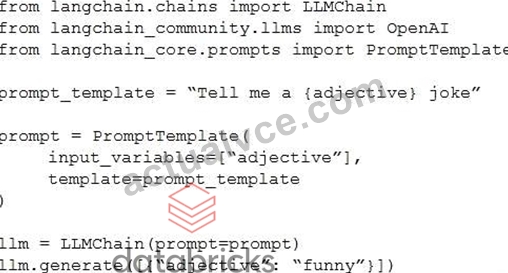
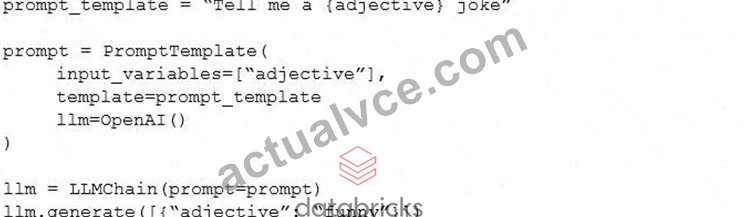
Assuming the API key was properly defined, what change does the Generative AI Engineer need to make to fix their chain?
- A.

- B.

- C.
- D.

Answer: C
Explanation:
To fix the error in the LangChain code provided for using a simple prompt template, the correct approach is Option C. Here's a detailed breakdown of why Option C is the right choice and how it addresses the issue:
* Proper Initialization: In Option C, the LLMChain is correctly initialized with the LLM instance specified as OpenAI(), which likely represents a language model (like GPT) from OpenAI. This is crucial as it specifies which model to use for generating responses.
* Correct Use of Classes and Methods:
* The PromptTemplate is defined with the correct format, specifying that adjective is a variable within the template. This allows dynamic insertion of values into the template when generating text.
* The prompt variable is properly linked with the PromptTemplate, and the final template string is passed correctly.
* The LLMChain correctly references the prompt and the initialized OpenAI() instance, ensuring that the template and the model are properly linked for generating output.
Why Other Options Are Incorrect:
* Option A: Misuses the parameter passing in generate method by incorrectly structuring the dictionary.
* Option B: Incorrectly uses prompt.format method which does not exist in the context of LLMChain and PromptTemplate configuration, resulting in potential errors.
* Option D: Incorrect order and setup in the initialization parameters for LLMChain, which would likely lead to a failure in recognizing the correct configuration for prompt and LLM usage.
Thus, Option C is correct because it ensures that the LangChain components are correctly set up and integrated, adhering to proper syntax and logical flow required by LangChain's architecture. This setup avoids common pitfalls such as type errors or method misuses, which are evident in other options.
NEW QUESTION # 51
A Generative Al Engineer is ready to deploy an LLM application written using Foundation Model APIs. They want to follow security best practices for production scenarios Which authentication method should they choose?
- A. Use an access token belonging to service principals
- B. Use an access token belonging to any workspace user
- C. Use a frequently rotated access token belonging to either a workspace user or a service principal
- D. Use OAuth machine-to-machine authentication
Answer: A
Explanation:
The task is to deploy an LLM application using Foundation Model APIs in a production environment while adhering to security best practices. Authentication is critical for securing access to Databricks resources, such as the Foundation Model API. Let's evaluate the options based on Databricks' security guidelines for production scenarios.
* Option A: Use an access token belonging to service principals
* Service principals are non-human identities designed for automated workflows and applications in Databricks. Using an access token tied to a service principal ensures that the authentication is scoped to the application, follows least-privilege principles (via role-based access control), and avoids reliance on individual user credentials. This is a security best practice for production deployments.
* Databricks Reference:"For production applications, use service principals with access tokens to authenticate securely, avoiding user-specific credentials"("Databricks Security Best Practices,"
2023). Additionally, the "Foundation Model API Documentation" states:"Service principal tokens are recommended for programmatic access to Foundation Model APIs."
* Option B: Use a frequently rotated access token belonging to either a workspace user or a service principal
* Frequent rotation enhances security by limiting token exposure, but tying the token to a workspace user introduces risks (e.g., user account changes, broader permissions). Including both user and service principal options dilutes the focus on application-specific security, making this less ideal than a service-principal-only approach. It also adds operational overhead without clear benefits over Option A.
* Databricks Reference:"While token rotation is a good practice, service principals are preferred over user accounts for application authentication"("Managing Tokens in Databricks," 2023).
* Option C: Use OAuth machine-to-machine authentication
* OAuth M2M (e.g., client credentials flow) is a secure method for application-to-service communication, often using service principals under the hood. However, Databricks' Foundation Model API primarily supports personal access tokens (PATs) or service principal tokens over full OAuth flows for simplicity in production setups. OAuth M2M adds complexity (e.g., managing refresh tokens) without a clear advantage in this context.
* Databricks Reference:"OAuth is supported in Databricks, but service principal tokens are simpler and sufficient for most API-based workloads"("Databricks Authentication Guide," 2023).
* Option D: Use an access token belonging to any workspace user
* Using a user's access token ties the application to an individual's identity, violating security best practices. It risks exposure if the user leaves, changes roles, or has overly broad permissions, and it's not scalable or auditable for production.
* Databricks Reference:"Avoid using personal user tokens for production applications due to security and governance concerns"("Databricks Security Best Practices," 2023).
Conclusion: Option A is the best choice, as it uses a service principal's access token, aligning with Databricks' security best practices for production LLM applications. It ensures secure, application-specific authentication with minimal complexity, as explicitly recommended for Foundation Model API deployments.
NEW QUESTION # 52
A Generative Al Engineer is creating an LLM system that will retrieve news articles from the year 1918 and related to a user's query and summarize them. The engineer has noticed that the summaries are generated well but often also include an explanation of how the summary was generated, which is undesirable.
Which change could the Generative Al Engineer perform to mitigate this issue?
- A. Revisit their document ingestion logic, ensuring that the news articles are being ingested properly.
- B. Tune the chunk size of news articles or experiment with different embedding models.
- C. Split the LLM output by newline characters to truncate away the summarization explanation.
- D. Provide few shot examples of desired output format to the system and/or user prompt.
Answer: D
Explanation:
To mitigate the issue of the LLM including explanations of how summaries are generated in its output, the best approach is to adjust the training or prompt structure. Here's why Option D is effective:
* Few-shot Learning: By providing specific examples of how the desired output should look (i.e., just the summary without explanation), the model learns the preferred format. This few-shot learning approach helps the model understand not only what content to generate but also how to format its responses.
* Prompt Engineering: Adjusting the user prompt to specify the desired output format clearly can guide the LLM to produce summaries without additional explanatory text. Effective prompt design is crucial in controlling the behavior of generative models.
Why Other Options Are Less Suitable:
* A: While technically feasible, splitting the output by newline and truncating could lead to loss of important content or create awkward breaks in the summary.
* B: Tuning chunk sizes or changing embedding models does not directly address the issue of the model's tendency to generate explanations along with summaries.
* C: Revisiting document ingestion logic ensures accurate source data but does not influence how the model formats its output.
By using few-shot examples and refining the prompt, the engineer directly influences the output format, making this approach the most targeted and effective solution.
NEW QUESTION # 53
......
True Databricks-Generative-AI-Engineer-Associate Exam Extraordinary Practice For the Exam: https://dumps4download.actualvce.com/Databricks/Databricks-Generative-AI-Engineer-Associate-valid-vce-dumps.html